Preferably a banned book, as it is Banned Books Week. I don't know which books I have on my shelf and which I don't so instead of following Sarah's example I'll examine the lists of most challenged/banned books from 2001-2008. Of those I've read:
Captain Underpants
Bridge to Terabithia
Julie of the Wolves
His Dark Materials series
Harry Potter series
The Adventures of Huckleberry Finn
Of Mice and Men
I Know Why the Caged Bird Sings
The Color Purple
I've put these in approximate age of readers. Captain Underpants is a beginning chapter book, I think, or read to your K-1st grader. I saw it was challenged for being "unsuited for age group" - well, I don't know about the people who challenged it but Mom and Nettie had the best time ever reading it together. It's the only one on the list I haven't read all of (OK, also haven't read Amber Spyglass, yet) but I think from the bits I have read/heard that it is perfect for the age group. Potty humor and burping is right up an average 6-9 yr old's alley, parent's might not always appreciate it but their kids love it. Mom and Nettie laughed the whole time.
The next three are (my impression) for late-elementary schoolers. I read Bridge to Terabithia and Julie of the Wolves in 6th grade, both for discussion/book reports. I'll admit that 6th grade was a while ago, so my memory may not be perfect but violence? I don't remember any particular violence in either. In BtT the kids have a fantasy world with battles against imaginary foes - you can't have kings and queens without dragons - but, in my mind, that's different than 'real' violence. It wasn't gratuitous or glorified. In JotW, Julie's village hunts, the wolf pack she joins hunts, but I can't for the life of me come up with any other potential violence to complain about. Maybe I've forgotten a bunch in the intervening 20 years? IDK, IDU either.
His Dark Materials is somewhat anti-church (in my reading really more anti-establishment or anti-dogma than anti-Christianity despite, perhaps, the author's intent) and this would make it a target of many book banners. Don't want the kiddos asking too many questions. Yeah, there's some violence but not gory and how do you have epic battles with out some violence? How many kids are going to read a trilogy that doesn't involve a major world changing conflict? And how many of those world changing conflicts are going to not involve a war? Yeah, you can do it, but the central conflict of the story needs to grab kids - war grabs kids (and adults).
It seems to me that the Harry Potter series starts as a mid- to late-elementary (3-5th grade) reading and ends as intermediate school reading (7-8th). I suspect a lot of the challenges to Harry Potter are because of the magic - inherently anti-church, if you're afraid of questions. My sister has a friend who isn't allowed to read the books or watch the movies because of this (but can watch Mary Poppins, go figure.). Yeah, there's violence. Violence with consequences and not without reason (at least for the good guys). Again the good guys are fighting evil, and Harry, et al. (due to an accident of birth) get sweep up in it. It's hard to fight evil without shedding some blood, Harry, Dumbledore or any of the other of our heroes, didn't started it but someone has to end it. BTW, sometime this happens in real life, not so much an 11 yr old kid being swept up into and being central to the resolution of the war, but bad things happen and sometimes young men and women have to go off to war - many not more than a year or two older than Harry, Hermione, and Ron in HPatDH - and kill or be killed.
I think kids can handle a little more than we tend to give them credit for. Or more than the idiots who ban books think they can. Not only can they handle people in a book fighting battles or hunting their food - they can tell the difference between reality and fantasy.
*post title is poorly purloined from RIF-Man lyrics
Showing posts with label reading. Show all posts
Showing posts with label reading. Show all posts
28 September 2009


29 April 2009
Random things I've been doing
Here's what I've been doing lately:
Getting sunburned
Alright gardening hasn't really taken up that much time but I have been planting stuff with help from Nettie. Someone's also been helping unplant things and it better not be one of my animals!
I went to the TBDC's The Roaring 20s dance weekend before last. I didn't have a costume for that one. (Flapper stuff was so boxy.) But I did have a costume for another one Friday night.
 70s Dance (@Forest Lake Meth.) I was going for the late 70s disco look. I'm not sure anyone appreciated it. (And I remembered my camera had a timer.)
I finished two books last weekend (yay 3-day!) and throughly enjoyed both The Engine's Child by Holly Phillips (deadwood) and Farthing by Jo Walton (free e-book from Tor). I'll be looking for more from both authors. (Best line from Farthing "he wished that people would read the rest of the things Jew aren't supposed to eat and take to serving us buttered lobster or shrimp on toast." Out of context they may not be so funny, even in context it's not LOL-funny, but it still has me giggling.)
Oh, and knitting (and some sewing but that's not quite done yet) A week and a half to Mother's Day and only one hole left to fix.
Getting sunburned
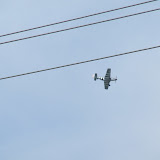 |
| T-town Airshow |
Alright gardening hasn't really taken up that much time but I have been planting stuff with help from Nettie. Someone's also been helping unplant things and it better not be one of my animals!
 |
| 2009 Garden |
I went to the TBDC's The Roaring 20s dance weekend before last. I didn't have a costume for that one. (Flapper stuff was so boxy.) But I did have a costume for another one Friday night.
 70s Dance (@Forest Lake Meth.) I was going for the late 70s disco look. I'm not sure anyone appreciated it. (And I remembered my camera had a timer.)
I finished two books last weekend (yay 3-day!) and throughly enjoyed both The Engine's Child by Holly Phillips (deadwood) and Farthing by Jo Walton (free e-book from Tor). I'll be looking for more from both authors. (Best line from Farthing "he wished that people would read the rest of the things Jew aren't supposed to eat and take to serving us buttered lobster or shrimp on toast." Out of context they may not be so funny, even in context it's not LOL-funny, but it still has me giggling.)
Oh, and knitting (and some sewing but that's not quite done yet)
 A week and a half to Mother's Day and only one hole left to fix.
24 July 2008
Top 100?
This list, via Chad, is the "Top 100 books" from the NEA/The Big Read (although I can't find the list on the site). Apparently most Americans have only read 6 of these. I find it a very odd list. There are a number of children's books. Just about all of Jane Austen's works, listed separately, but Shakespeare gets only two? (one being "complete works of") The Da Vinci Code? No Faulkner, Bradbury, or Vonnegut?
Here's my list. (Bolded titles are the books I've read; books in italics are ones I've seen movie adaptations for; an asterisk is for books I started and didn't finish; a caret for the books I intend to read):
1 Pride and Prejudice - Jane Austen
2 The Lord of the Rings - JRR Tolkien
3 Jane Eyre - Charlotte Bronte
4 Harry Potter series - JK Rowling
5 To Kill a Mockingbird - Harper Lee
6 The Bible (most of it)
7 Wuthering Heights - Emily Bronte*
8 Nineteen Eighty Four - George Orwell
9 His Dark Materials - Philip Pullman (book 1)^
10 Great Expectations - Charles Dickens
11 Little Women - Louisa M Alcott
12 Tess of the D'Urbervilles - Thomas Hardy
13 Catch 22 - Joseph Heller*^
14 Complete Works of Shakespeare
15 Rebecca - Daphne Du Maurier
16 The Hobbit - JRR Tolkien
17 Birdsong - Sebastian Faulks
18 Catcher in the Rye - JD Salinger
19 The Time Traveller's Wife - Audrey Niffenegger
20 Middlemarch - George Eliot
21 Gone With The Wind - Margaret Mitchell
22 The Great Gatsby - F Scott Fitzgerald
23 Bleak House - Charles Dickens
24 War and Peace - Leo Tolstoy
25 The Hitch Hiker's Guide to the Galaxy - Douglas Adams
26 Brideshead Revisited - Evelyn Waugh^
27 Crime and Punishment - Fyodor Dostoyevsky
28 Grapes of Wrath - John Steinbeck
29 Alice in Wonderland - Lewis Carroll
30 The Wind in the Willows - Kenneth Grahame
31 Anna Karenina - Leo Tolstoy
32 David Copperfield - Charles Dickens
33 Chronicles of Narnia - CS Lewis
34 Emma - Jane Austen
35 Persuasion - Jane Austen
36 The Lion, The Witch and The Wardrobe - CS Lewis
37 The Kite Runner - Khaled Hosseini^
38 Captain Corelli's Mandolin - Louis De Bernieres
39 Memoirs of a Geisha - Arthur Golden
40 Winnie the Pooh - AA Milne
41 Animal Farm - George Orwell^
42 The Da Vinci Code - Dan Brown
43 One Hundred Years of Solitude - Gabriel Garcia Marquez
44 A Prayer for Owen Meany - John Irving
45 The Woman in White - Wilkie Collins
46 Anne of Green Gables - LM Montgomery
47 Far From The Madding Crowd - Thomas Hardy
48 The Handmaid's Tale - Margaret Atwood
49 Lord of the Flies - William Golding
50 Atonement - Ian McEwan
51 Life of Pi - Yann Martel
52 Dune - Frank Herbert
53 Cold Comfort Farm - Stella Gibbons
54 Sense and Sensibility - Jane Austen
55 A Suitable Boy - Vikram Seth
56 The Shadow of the Wind - Carlos Ruiz Zafon
57 A Tale Of Two Cities - Charles Dickens
58 Brave New World - Aldous Huxley^
59 The Curious Incident of the Dog in the Night-time - Mark Haddon
60 Love In The Time Of Cholera - Gabriel Garcia Marquez
61 Of Mice and Men - John Steinbeck
62 Lolita - Vladimir Nabokov^
63 The Secret History - Donna Tartt
64 The Lovely Bones - Alice Sebold
65 Count of Monte Cristo - Alexandre Dumas
66 On The Road - Jack Kerouac
67 Jude the Obscure - Thomas Hardy
68 Bridget Jones's Diary - Helen Fielding
69 Midnight's Children - Salman Rushdie
70 Moby Dick - Herman Melville
71 Oliver Twist - Charles Dickens
72 Dracula - Bram Stoker
73 The Secret Garden - Frances Hodgson Burnett
74 Notes From A Small Island - Bill Bryson
75 Ulysses - James Joyce
76 The Bell Jar - Sylvia Plath
77 Swallows and Amazons - Arthur Ransome
78 Germinal - Emile Zola
79 Vanity Fair - William Makepeace Thackeray
80 Possession - AS Byatt
81 A Christmas Carol - Charles Dickens
82 Cloud Atlas - David Mitchell
83 The Color Purple - Alice Walker
84 The Remains of the Day - Kazuo Ishiguro
85 Madame Bovary - Gustave Flaubert
86 A Fine Balance - Rohinton Mistry
87 Charlotte's Web - EB White
88 The Five People You Meet In Heaven - Mitch Albom
89 Adventures of Sherlock Holmes - Sir Arthur Conan Doyle
90 The Faraway Tree Collection
91 Heart of Darkness - Joseph Conrad
92 The Little Prince - Antoine De Saint-Exupery
93 The Wasp Factory - Iain Banks
94 Watership Down - Richard Adams
95 A Confederacy of Dunces - John Kennedy Toole
96 A Town Like Alice - Nevil Shute
97 The Three Musketeers - Alexandre Dumas
98 Hamlet - William Shakespeare
99 Charlie and the Chocolate Factory - Roald Dahl
100 Les Miserables - Victor Hugo
A few comments on the my list - I devoured Da Vinci Code but don't think it belongs on a list of great or must read books. I've read some Waugh and Dostoyevsky, just not the titles listed here. I've tried to read Victorian novels and find them deadly dull, but I love the movie adaptations (and Masterpiece Theater just did the complete Jane Austen this spring) so I've seen the Austen and Bronte sisters' works on the small screen but have no intention of reading them. I'm not a huge fan of Dickens but have read a few and generally like the movies. The NPR station in DC played the BBC radio (I think) production of Hitchhiker's Guide when I was a kid; I loved listening to it as much as I enjoyed reading it. I haven't seen the whole movie adaptation yet, I'm a little afraid to. I've not read the entire works of Shakespeare but have read (and studied) four or five plays. I'm not much of a play reader, I don't sink into the story the same way I do with a book. Wuthering Heights is the only book I was suppose to read but didn't finish. It was assigned as summer reading for rising 12th graders which, because of our move, I didn't learn about until 4 days before school started. It is, I believe, the only thing I ever bought Cliff Notes for. So I've read 24 of them, then again I've never claimed I had good taste in books.
What, dear reader, do you think of the list?
Here's my list. (Bolded titles are the books I've read; books in italics are ones I've seen movie adaptations for; an asterisk is for books I started and didn't finish; a caret for the books I intend to read):
1 Pride and Prejudice - Jane Austen
2 The Lord of the Rings - JRR Tolkien
3 Jane Eyre - Charlotte Bronte
4 Harry Potter series - JK Rowling
5 To Kill a Mockingbird - Harper Lee
6 The Bible (most of it)
7 Wuthering Heights - Emily Bronte*
8 Nineteen Eighty Four - George Orwell
9 His Dark Materials - Philip Pullman (book 1)^
10 Great Expectations - Charles Dickens
11 Little Women - Louisa M Alcott
12 Tess of the D'Urbervilles - Thomas Hardy
13 Catch 22 - Joseph Heller*^
14 Complete Works of Shakespeare
15 Rebecca - Daphne Du Maurier
16 The Hobbit - JRR Tolkien
17 Birdsong - Sebastian Faulks
18 Catcher in the Rye - JD Salinger
19 The Time Traveller's Wife - Audrey Niffenegger
20 Middlemarch - George Eliot
21 Gone With The Wind - Margaret Mitchell
22 The Great Gatsby - F Scott Fitzgerald
23 Bleak House - Charles Dickens
24 War and Peace - Leo Tolstoy
25 The Hitch Hiker's Guide to the Galaxy - Douglas Adams
26 Brideshead Revisited - Evelyn Waugh^
27 Crime and Punishment - Fyodor Dostoyevsky
28 Grapes of Wrath - John Steinbeck
29 Alice in Wonderland - Lewis Carroll
30 The Wind in the Willows - Kenneth Grahame
31 Anna Karenina - Leo Tolstoy
32 David Copperfield - Charles Dickens
33 Chronicles of Narnia - CS Lewis
34 Emma - Jane Austen
35 Persuasion - Jane Austen
36 The Lion, The Witch and The Wardrobe - CS Lewis
37 The Kite Runner - Khaled Hosseini^
38 Captain Corelli's Mandolin - Louis De Bernieres
39 Memoirs of a Geisha - Arthur Golden
40 Winnie the Pooh - AA Milne
41 Animal Farm - George Orwell^
42 The Da Vinci Code - Dan Brown
43 One Hundred Years of Solitude - Gabriel Garcia Marquez
44 A Prayer for Owen Meany - John Irving
45 The Woman in White - Wilkie Collins
46 Anne of Green Gables - LM Montgomery
47 Far From The Madding Crowd - Thomas Hardy
48 The Handmaid's Tale - Margaret Atwood
49 Lord of the Flies - William Golding
50 Atonement - Ian McEwan
51 Life of Pi - Yann Martel
52 Dune - Frank Herbert
53 Cold Comfort Farm - Stella Gibbons
54 Sense and Sensibility - Jane Austen
55 A Suitable Boy - Vikram Seth
56 The Shadow of the Wind - Carlos Ruiz Zafon
57 A Tale Of Two Cities - Charles Dickens
58 Brave New World - Aldous Huxley^
59 The Curious Incident of the Dog in the Night-time - Mark Haddon
60 Love In The Time Of Cholera - Gabriel Garcia Marquez
61 Of Mice and Men - John Steinbeck
62 Lolita - Vladimir Nabokov^
63 The Secret History - Donna Tartt
64 The Lovely Bones - Alice Sebold
65 Count of Monte Cristo - Alexandre Dumas
66 On The Road - Jack Kerouac
67 Jude the Obscure - Thomas Hardy
68 Bridget Jones's Diary - Helen Fielding
69 Midnight's Children - Salman Rushdie
70 Moby Dick - Herman Melville
71 Oliver Twist - Charles Dickens
72 Dracula - Bram Stoker
73 The Secret Garden - Frances Hodgson Burnett
74 Notes From A Small Island - Bill Bryson
75 Ulysses - James Joyce
76 The Bell Jar - Sylvia Plath
77 Swallows and Amazons - Arthur Ransome
78 Germinal - Emile Zola
79 Vanity Fair - William Makepeace Thackeray
80 Possession - AS Byatt
81 A Christmas Carol - Charles Dickens
82 Cloud Atlas - David Mitchell
83 The Color Purple - Alice Walker
84 The Remains of the Day - Kazuo Ishiguro
85 Madame Bovary - Gustave Flaubert
86 A Fine Balance - Rohinton Mistry
87 Charlotte's Web - EB White
88 The Five People You Meet In Heaven - Mitch Albom
89 Adventures of Sherlock Holmes - Sir Arthur Conan Doyle
90 The Faraway Tree Collection
91 Heart of Darkness - Joseph Conrad
92 The Little Prince - Antoine De Saint-Exupery
93 The Wasp Factory - Iain Banks
94 Watership Down - Richard Adams
95 A Confederacy of Dunces - John Kennedy Toole
96 A Town Like Alice - Nevil Shute
97 The Three Musketeers - Alexandre Dumas
98 Hamlet - William Shakespeare
99 Charlie and the Chocolate Factory - Roald Dahl
100 Les Miserables - Victor Hugo
A few comments on the my list - I devoured Da Vinci Code but don't think it belongs on a list of great or must read books. I've read some Waugh and Dostoyevsky, just not the titles listed here. I've tried to read Victorian novels and find them deadly dull, but I love the movie adaptations (and Masterpiece Theater just did the complete Jane Austen this spring) so I've seen the Austen and Bronte sisters' works on the small screen but have no intention of reading them. I'm not a huge fan of Dickens but have read a few and generally like the movies. The NPR station in DC played the BBC radio (I think) production of Hitchhiker's Guide when I was a kid; I loved listening to it as much as I enjoyed reading it. I haven't seen the whole movie adaptation yet, I'm a little afraid to. I've not read the entire works of Shakespeare but have read (and studied) four or five plays. I'm not much of a play reader, I don't sink into the story the same way I do with a book. Wuthering Heights is the only book I was suppose to read but didn't finish. It was assigned as summer reading for rising 12th graders which, because of our move, I didn't learn about until 4 days before school started. It is, I believe, the only thing I ever bought Cliff Notes for. So I've read 24 of them, then again I've never claimed I had good taste in books.
What, dear reader, do you think of the list?
22 April 2008
Free Love? Free Bodies?
Two oddly related readings from Tuesday on Brazilian waxes and Open Source Boobs.*
I'll let you draw the connections.
Cohen gets one thing wrong - while Victorian women wore long dresses they hardly kept their cleavage under wraps, at least in formal wear. And even when covered they were hardly hidden. The corset may have restricted breathing and therefore kept women seemingly delicate (and non-lusty) but it also pushed the breasts up and accentuated a woman's curves. Hardly a good way to hide sexuality. Corsets did, however, create a sort of sameness to the look of all women - very narrow waist, high breasts, and wide hips (sometimes with the help of crinolines, hoops, and bustles). Victorians were neither the first nor the last to attempt to standardize beauty.
I had more to say about OPSP but The Ferret has a long update to his post that says much of it and the rest I was having a hard time articulating.
*Found by way of Whatever.
I'll let you draw the connections.
Cohen gets one thing wrong - while Victorian women wore long dresses they hardly kept their cleavage under wraps, at least in formal wear. And even when covered they were hardly hidden. The corset may have restricted breathing and therefore kept women seemingly delicate (and non-lusty) but it also pushed the breasts up and accentuated a woman's curves. Hardly a good way to hide sexuality. Corsets did, however, create a sort of sameness to the look of all women - very narrow waist, high breasts, and wide hips (sometimes with the help of crinolines, hoops, and bustles). Victorians were neither the first nor the last to attempt to standardize beauty.
I had more to say about OPSP but The Ferret has a long update to his post that says much of it and the rest I was having a hard time articulating.
*Found by way of Whatever.
02 October 2007
Eeyore
My sister says "With my luck...." and means it. We all (or most of us anyway) have at one time or another said "with my luck [something bad will happen/continue to happen]" but most of us aren't serious. It is more of a expression of frustration or defeat than of actual belief. My sister seems to believe it. A friend of mine (and her co-worker) likened my sister to Eeyore. Now she may be the "office Eeyore", but his description of her and how she is like Eeyore didn't sit well with me.
Sis will tell everyone, and just about anyone, everything that is going wrong in her life from not getting off the days she requested to her car being reposed. And she often acts/talks like somehow the world is out to get her. These traits would make her a source of depressing conversation but that doesn't make her depressed and Eeyore isn't paranoid.
Eeyore is in the grips of a serious depression. He doesn't think the world, or anyone in it, cares about him. In order for the world to be out to get you, it has to know you are alive. He is genuinely surprised when people do nice things for him. (One of his Disney-catchphrases is "thanks for noticin' me.") He doesn't expect good things to happen or anyone to care. He doesn't want to bother other people. He just sits in his house of sticks and ponders things*. I should know I strongly identify with Eeyore. (or as he spells it Eor.)
I tried to convince my friend that I'm more like Eeyore than my sister but he wouldn't have any of it, then our movie started and conversation ceased in favor of Halle Berry, Bruce Willis and Taco Bell.
*Please note it has been a while since I read any A.A. Milne or watched Winnie-the-Pooh on TV (or movies) so my impressions may be inaccurate and colored towards the Disney version watched more recently. Wikipedia actual has a nice, I think, description of Eeyore and the British-ness of his personality. And while I'm on the subject, I generally prefer Shepard's illustrations (or the other early renditions) and the "classic Winnie-the-Pooh" over Disney's except I do like the blue-grey of Eeyore's coat of the Disney marketed items. (BTW, Pooh should not be bright yellow, but honey-gold)
Sis will tell everyone, and just about anyone, everything that is going wrong in her life from not getting off the days she requested to her car being reposed. And she often acts/talks like somehow the world is out to get her. These traits would make her a source of depressing conversation but that doesn't make her depressed and Eeyore isn't paranoid.
Eeyore is in the grips of a serious depression. He doesn't think the world, or anyone in it, cares about him. In order for the world to be out to get you, it has to know you are alive. He is genuinely surprised when people do nice things for him. (One of his Disney-catchphrases is "thanks for noticin' me.") He doesn't expect good things to happen or anyone to care. He doesn't want to bother other people. He just sits in his house of sticks and ponders things*. I should know I strongly identify with Eeyore. (or as he spells it Eor.)
I tried to convince my friend that I'm more like Eeyore than my sister but he wouldn't have any of it, then our movie started and conversation ceased in favor of Halle Berry, Bruce Willis and Taco Bell.
*Please note it has been a while since I read any A.A. Milne or watched Winnie-the-Pooh on TV (or movies) so my impressions may be inaccurate and colored towards the Disney version watched more recently. Wikipedia actual has a nice, I think, description of Eeyore and the British-ness of his personality. And while I'm on the subject, I generally prefer Shepard's illustrations (or the other early renditions) and the "classic Winnie-the-Pooh" over Disney's except I do like the blue-grey of Eeyore's coat of the Disney marketed items. (BTW, Pooh should not be bright yellow, but honey-gold)
15 August 2007
Middle English
For your inner English-geek, may I present Scalzi Chaucer'd.
Anyone know where we can get it in Old English, too?
Anyone know where we can get it in Old English, too?
10 August 2007
But is it important in this universe?
Recently read John Scalzi's (at Whatever) explanation of why he rarely gives his characters a skin color and Kameron Hurley's (at Brutal Women) response to Scalzi's post. Here's my thoughts on it.
As I read it: Scalzi is saying he doesn't give his characters a skin color because it isn't important to the story. If it is important than he makes sure it is in there. He does, however, write non-white characters; he just doesn't go around describing their skin color. Hurley is saying that if a character is explicitly not white, middle-class male than that is the default. Hurley also says that it is important to make the distinction because there are cultural differences.
First off, in three of Scalzi's books the main characters are GREEN. The bodies grown for the CDF soldiers are green to make them easy to identify. It also means that based on skin color there is no indication of country of origin or ancestry, so one has to resort to guessing by name. Presumably, when their tour of duty is over new bodies the soldiers get have whatever skin color originally encoded for in their genes.
Scalzi doesn't ignore race in the Old Man's War universe. Soldiers come from developed nations (USA, Canada, western Europe, China,...) and colonist come from third world countries (India, Sub-Saharan Africa, Southeast Asia...), IIRC. Apparently, the racial politics are even directly part of The Last Colony. As I remember characters have varied names suggesting different countries of origin and/or ancestry but there is no big deal made about it.
Science fiction stories usually take place in future; only a few are set within any of our potential lifetimes and many take place in the distant future. That means that the cultural differences that exist today most likely do not exist at the time of the story. Even a hundred years could be enough to erase the differences in east coast inner-city boy and mid-west farm girl. Some differences will remain whether within a country or around the world, but many of the differences that are seen in today's society could disappear; particularly those primarily due to differences in ancestry because we are becoming a more homogenized culture (for better or worse). I like to think that the lack of importance of race in many sci-fi books is the result of the author's desire to see race be less important; they really want the world to be color-blind, at least within one a give country. This is probably a projection of my desire for there to be less emphasis put on one's skin color.
Another example of race/culture in literature is in the Harry Potter books. J.K. Rowling has students of many different ancestry at Hogwarts. Harry, Hermione, and Ron are Anglo-Saxon, Blaise Zabini is African, the Patil sisters' names suggest they are Indian, and Cho Chang is a Chinese name; and they are all English. I'm sure there are some Welsh students. Professor McGonagall is Scottish. Seamus is Irish. Most students are "white" but the school is in England. What do you expect? They reflect the population of Great Britain.
Ms. Hurley, my primary problem with your rant is, is the difference between an inner-city Hispanic-American boy and an inner-city African-American boy more or less than the difference between an inner-city African-American boy and an upper class African-American boy?
I don't think so. Certainly using characters from different cultures opens up different potential sub-plots, but culture is not based on skin color. It is based on where one was raised.
Slight aside: Scalzi's successful creation of a character without specifying gender ( scroll down to April 18th, for his explanation) may suggest that Hurley is wrong from the get go since being named 'Sam' and in a relationship with the male, Archie, did not make Sam a female for all readers. Most readers would have imagined Sam as male or female but some may have imagined intersex. I haven't read Android's Dream, so I don't have an opinion, yet.
As I read it: Scalzi is saying he doesn't give his characters a skin color because it isn't important to the story. If it is important than he makes sure it is in there. He does, however, write non-white characters; he just doesn't go around describing their skin color. Hurley is saying that if a character is explicitly not white, middle-class male than that is the default. Hurley also says that it is important to make the distinction because there are cultural differences.
First off, in three of Scalzi's books the main characters are GREEN. The bodies grown for the CDF soldiers are green to make them easy to identify. It also means that based on skin color there is no indication of country of origin or ancestry, so one has to resort to guessing by name. Presumably, when their tour of duty is over new bodies the soldiers get have whatever skin color originally encoded for in their genes.
Scalzi doesn't ignore race in the Old Man's War universe. Soldiers come from developed nations (USA, Canada, western Europe, China,...) and colonist come from third world countries (India, Sub-Saharan Africa, Southeast Asia...), IIRC. Apparently, the racial politics are even directly part of The Last Colony. As I remember characters have varied names suggesting different countries of origin and/or ancestry but there is no big deal made about it.
Science fiction stories usually take place in future; only a few are set within any of our potential lifetimes and many take place in the distant future. That means that the cultural differences that exist today most likely do not exist at the time of the story. Even a hundred years could be enough to erase the differences in east coast inner-city boy and mid-west farm girl. Some differences will remain whether within a country or around the world, but many of the differences that are seen in today's society could disappear; particularly those primarily due to differences in ancestry because we are becoming a more homogenized culture (for better or worse). I like to think that the lack of importance of race in many sci-fi books is the result of the author's desire to see race be less important; they really want the world to be color-blind, at least within one a give country. This is probably a projection of my desire for there to be less emphasis put on one's skin color.
Another example of race/culture in literature is in the Harry Potter books. J.K. Rowling has students of many different ancestry at Hogwarts. Harry, Hermione, and Ron are Anglo-Saxon, Blaise Zabini is African, the Patil sisters' names suggest they are Indian, and Cho Chang is a Chinese name; and they are all English. I'm sure there are some Welsh students. Professor McGonagall is Scottish. Seamus is Irish. Most students are "white" but the school is in England. What do you expect? They reflect the population of Great Britain.
Ms. Hurley, my primary problem with your rant is, is the difference between an inner-city Hispanic-American boy and an inner-city African-American boy more or less than the difference between an inner-city African-American boy and an upper class African-American boy?
I don't think so. Certainly using characters from different cultures opens up different potential sub-plots, but culture is not based on skin color. It is based on where one was raised.
Slight aside: Scalzi's successful creation of a character without specifying gender ( scroll down to April 18th, for his explanation) may suggest that Hurley is wrong from the get go since being named 'Sam' and in a relationship with the male, Archie, did not make Sam a female for all readers. Most readers would have imagined Sam as male or female but some may have imagined intersex. I haven't read Android's Dream, so I don't have an opinion, yet.
Subscribe to:
Posts (Atom)
